Clinical problem
Pharmacists need to move between orders, labs, EMR narratives, nursing records, culture results, calculators, and Word templates before making a practical recommendation.
Data fragmentation
Documentation burden
Decision latency
A pharmacist-facing workbench that reorganizes hospital data into daily clinical decisions, documentation, TDM/PK support, and pharmacy quality workflows.
Pharmacists need to move between orders, labs, EMR narratives, nursing records, culture results, calculators, and Word templates before making a practical recommendation.
A modular workstation covering patient monitoring, Patient 360, ward rounds, consultations, MTM clinic, TDM, neonatal pharmacy, clinical pathways, order review, and quality control.
I translated clinical pharmacy workflows into data-driven modules, exportable documents, risk filters, and review surfaces aligned with real hospital work.
A de-identified English preview showing the workstation as a clinical cockpit rather than a static report page.
The interface keeps patient risk, medication context, timelines, TDM/PK calculation, and exportable notes close to the pharmacist’s daily decision path.
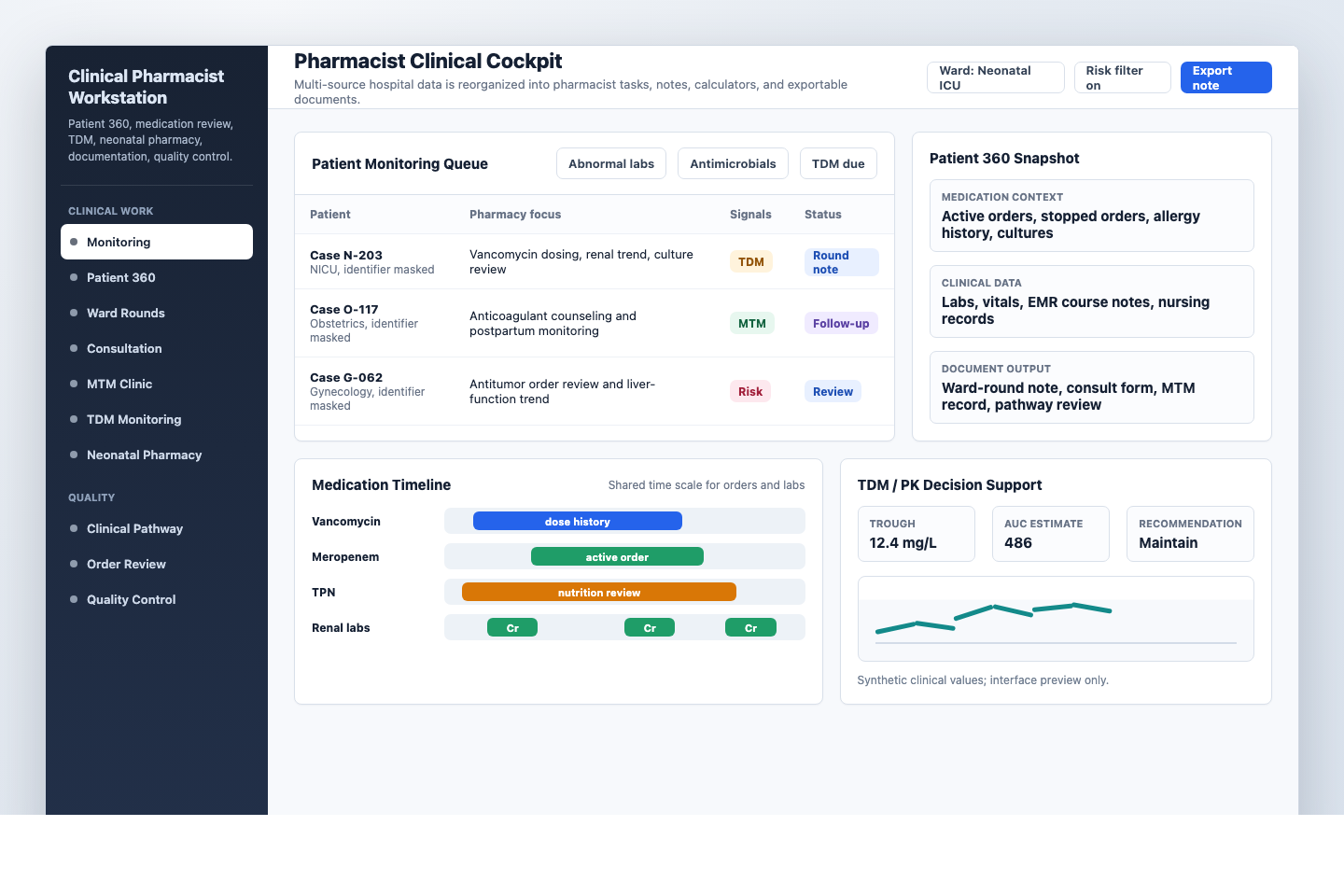
The workstation is strongest when viewed as an integrated clinical operating system for pharmacists.
Patient cards, risk flags, order context, abnormal laboratory results, nursing/EMR traces, and department filters support fast prioritization.
Vancomycin dosing, dose adjustment, simulation, and report workflows bring pharmacokinetic reasoning into the same work surface.
Ward-round notes, consultation records, MTM follow-up, clinical pathway review, and order-review outputs are designed for real hospital documentation formats.
The workstation shows the ability to build usable AI-adjacent infrastructure around pharmacist judgment, not merely a dashboard.
The system reorganizes complex hospital data around actions pharmacists actually take: assess risk, write notes, adjust therapy, and produce auditable outputs.
Multiple pharmacy service areas are connected through consistent patient context and documentation patterns, reducing isolated one-off tools.
The emphasis on export formats, editable records, and ward-level work surfaces makes the platform understandable to clinicians and hospital managers.